LESSON 04 // EDITORIAL CRAFT

Storytelling: Keep the Visual Thread

When you remove commercial product pitches from a carousel, what remains is human observation: how a team solves a spatial problem, how a landscape changes over a season, or how a print evolves from sketch to press.

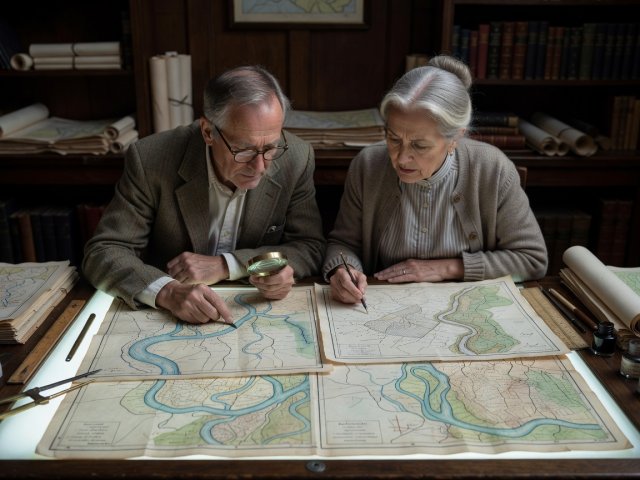
Two cartographic archivists leaning over a light table comparing hand-drawn river surveys

FIG 05. Visual continuity depends on linking each photograph's focal point to the next.

WORKING EXAMPLE // SEQUENTIAL ALT TEXT VS. ISOLATED LABELS

Writing Alt Descriptions That Carry the Thread

Screen-reader users experience a carousel as a connected series of image descriptions and captions. Compare how isolated alt text drops the narrative thread, while sequential alt text honours the progression:

Slide Weak Isolated Alt Text Strong Sequential Workshop Alt Text
Slide 1 "People looking at prints on a desk" "Bindery team spreading 24 loose botanical folio sheets across an oak workbench to sort by paper weight."
Slide 2 "Close up of sewing thread and paper" "Close view of the sorted folio signatures clamped in a wooden sewing frame as linen thread joins the spine."
Slide 3 "Open book on a table" "The completed stitched volume lying completely flat on a reading cradle, showing unbroken botanical drawings across the gutter."
LESSON 4A // CAPTION COMPLEMENTARITY

Alt Text Describes the Sight; Captions Explain the Significance

Beginners frequently copy and paste the exact same sentence into both the alt attribute and the visible <figcaption>, causing screen readers to read the sentence twice in a row. Let the alt attribute describe what is visually present in the frame, and use the visible caption to provide dates, motives, or unseen context.

See FAQ on alt text vs. captions →
LESSON 4B // VISUAL TRANSITIONS

Matching Eyelines and Horizon Lines Across Slides

When a viewer clicks "Next" and the image switches in place, their eye remains focused on the exact spot where the previous subject stood. Keeping horizon lines or focal subjects in harmonious regions across consecutive frames makes manual stepping feel effortless.

Review the four-act storyboard →
EDITORIAL ETHICS // PRODUCT-FREE SHOWCASES

Why Non-Commercial Visual Showcases Need Calm Pacing

Much of the web's distrust of carousels stems from aggressive e-commerce patterns: flashing countdown banners, auto-scrolling "recommended items", and dark-pattern sliders designed to manufacture urgency. When independent studios, museums, universities, and civic organizations adopt those same frantic mechanics for documentary or educational work, they inadvertently undermine their own credibility.

In a workshop or archival context, the viewer is not shopping for a commodity—they are trying to understand a process or examine primary visual evidence. Giving every image a clear job means trimming redundant frames ruthlessly. If two photographs show the exact same workshop table from five degrees apart, pick the one where the collaborator's gesture is clearest and leave the second out of the carousel.

Next: Carousel Decisions Explained (FAQ) →